GenAI Beyond Chatbots for Legacy Modernization
Chatbots get the headlines. The real wins happen backstage.
In 2025 the most useful work from generative AI is not talking to customers. It is helping teams understand, stabilize, and safely evolve the old systems that still run the business. This is a field guide to where AI pays off inside legacy stacks, based on what we see day to day with LensHub.
1) Turning unknown code into a living map
Most legacy problems start with missing context. Files grew over years, owners moved on, and documentation fell out of date. Generative models finally make codebase understanding fast enough to be practical.
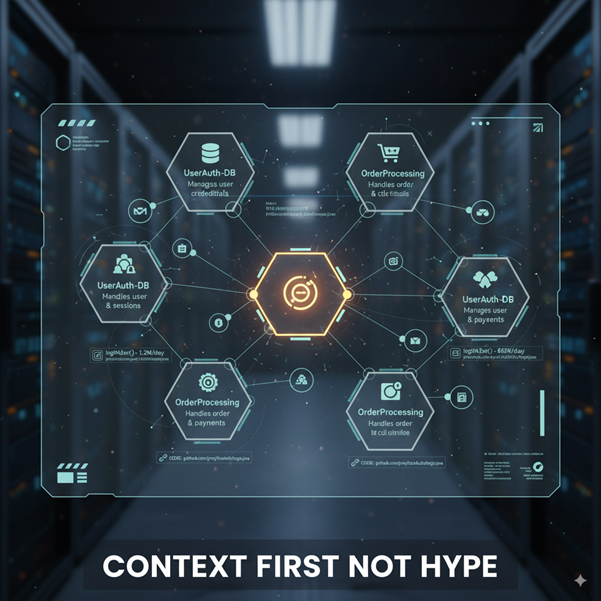
LensHub feeds an LLM the repository, commit history, and runtime traces to produce a map that humans can skim. You get subsystem summaries, dependency graphs, and plain language explanations for the top fifty functions by call volume. Dead or duplicate paths are flagged. Old patterns like hand rolled caching or custom XML parsers get highlighted with reasons to keep or replace. Engineers begin work with a story of the system, not a folder of guesses.
Why it works: Models are good at compression. They read a million lines, then explain the shape of it in a few pages that people can trust because links point back to the code.
2) Preserving institutional knowledge before it walks out the door
Legacy systems often run on folklore. A senior engineer knows the three places where a flag must change together. An analyst knows the order of CSV drops that keep a nightly job happy. That knowledge evaporates during churn.
With LensHub, generative AI turns commit diffs, ticket text, and production incidents into versioned notes that look like the documentation you wish existed. Think of it as ADRs written after the fact. For every hot path the system keeps a "why this exists" card, owners, and the risks of change. New hires ramp faster. Reviews get fewer surprises. People leave and the system still remembers.
Why it works: Models are good at stitching narratives. They extract intent from scattered artifacts and keep it attached to the code that matters.
3) Test scaffolding that reflects how users really use the system
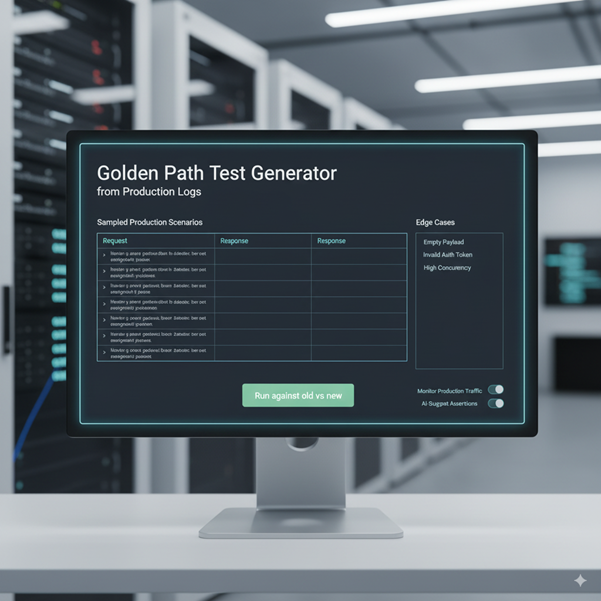
Most legacy services are under tested in the places that matter. The fastest way to gain confidence is to test what users actually do. LensHub uses production logs to synthesize "golden path" examples. For each key endpoint the system generates request and response pairs, edge cases from real traffic, and a small harness to run them against old and new implementations.
When you refactor, upgrade Java or .NET, or replace a WCF edge with REST, you run these examples first. If outputs match, you move forward. If not, you know why. This keeps upgrades boring and rollouts calm.
Why it works: Models are good at templating and variation. Give them a few real calls and they create a tidy test set that matches reality, not assumptions.
4) API mediation when providers and schemas drift
Integrations break in quiet ways. A partner adds a new enum value. A field becomes optional. A date format changes on one route only. Incidents follow. Generative AI helps by watching observed responses over time and writing guardrails.
LensHub detects drift between the public spec and real responses, then generates contracts and small adapters that normalize inputs and outputs at the edges. Teams keep their internal models stable while partners evolve. You stop discovering changes from 2 a.m. pages.
Why it works: Models are good at schema inference and transformation rules. They do not replace validation. They generate it.
5) Translating reports and queries without losing the math
A lot of "legacy" is SQL in strange places. Access reports, SAS scripts, stored procedures that grew into small applications. Replacing them is risky because people trust the current totals.
With LensHub, generative AI reads the old query or script, explains it in English, proposes an equivalent in a modern stack, and builds a parity harness that compares outputs on historical data. Finance can sign off because they see side by side numbers. Engineering can ship because the new code has a proof.
Why it works: Models are good at explanation and first draft translation, and they become reliable when paired with automated parity checks.
6) Faster incident sense making
Logs are noisy. During an incident the first win is a clean summary. LensHub uses generative models to condense a window of logs and traces into a short timeline: what changed, which services are involved, which error signatures are new, and which rollbacks are likely to help. The on call engineer gets a starting point instead of a haystack.
After the fix the model drafts a post incident note with links to evidence and a list of watch items. Knowledge builds with every event rather than evaporating at 3 a.m.
Why it works: Models are good at summarization across many small signals. They give humans a head start when time matters.
7) Finding and taming shadow systems
Every enterprise has spreadsheets, Zapier flows, and scripts that quietly run parts of the business. They are useful until they are fragile. LensHub learns their behavioral footprint from access logs, file movements, and odd API calls, then drafts a consolidation plan. The plan groups duplicate logic, proposes official endpoints, and includes change notes owners can review. You keep the intent while removing the risk.
Why it works: Models are good at pattern spotting across messy metadata and at writing the migration notes humans can accept.
8) Planning modernization as a series of safe bets
Leaders do not want slogans. They want a sequence. Generative AI helps turn a giant problem into an ordered list of winnable steps. LensHub evaluates each candidate change on business value, coupling, test coverage, and runtime volatility, then writes a short brief per step. Each brief includes what to move, how to prove parity, expected savings, and rollback plan.
This lets teams modernize in slices while revenue work continues. You get progress you can show each month.
Why it works: Models are good at ranking and proposal writing when fed the right facts. They do the paperwork so people can do the work.
What AI should not do in legacy systems
It should not write to production without guardrails. It should not invent facts in documentation. It should not replace human review for security, privacy, or compliance. LensHub keeps models inside a safe lane. Suggestions become diffs, docs, and tests that humans approve. Verification sits between words and running code.
A short story to make it concrete
A finance platform wanted to move from Java 8 to Java 21 and clean up a web of reports that lived in SQL and SAS. We used LensHub to map the code, generate golden path tests, and draft report translations with parity checks. We added adapters where partner APIs drifted. We captured the "why" behind a dozen risky functions that only one engineer understood.
Cutovers happened in small ramps. Reports matched to the cent on old data before anyone touched production. Startup times fell. Autoscaling got cheaper. Incidents dropped because adapters fenced off provider quirks. The team shipped features every week the whole time.
None of that involved a chatbot. All of it involved generative models doing quiet work that people used and verified.
Closing thought
Generative AI is not magic. It is a force multiplier when it works beside engineers, not in front of them. In legacy environments the best use cases are simple to describe. See the system clearly. Keep its memory. Prove parity before change. Fence off drift. Write fewer tickets by hand. Ship with less fear.
Discover GenAI for Your Legacy Stack
If you want to try this in your stack, ask for a ten day AI in legacy pilot. We will deliver a code map, a parity test suite, three refactor candidates with briefs, and a small set of API guardrails that stop the next surprise before it wakes you up.