Java 8 to Java 21 Upgrade Without Downtime
A practical story about parity, confidence, and quiet wins
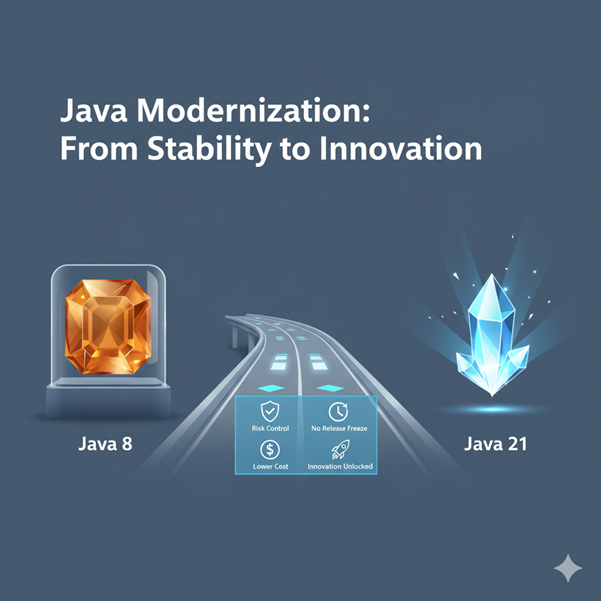
Most upgrade plans begin with a slide about new features. That is the wrong starting point. When you are moving a live product from Java 8 to Java 21, the first promise you must make is simple. The same inputs produce the same outputs, and customers never notice the change. Everything else is a bonus.
This is a playbook told as a story, not as a checklist. It is about how teams earn confidence, persuade finance, and keep shipping while they move.
The moment of truth
A team we worked with had a familiar setup. Java 8 services that had not been touched at the runtime level in years. Releases every Friday. A product roadmap that did not care about the JVM.
Their fear was not the upgrade itself. It was the loss of rhythm. If they paused features to chase runtime errors, momentum would stall and trust would fade. So we framed the work around one rule. Preserve behavior first. Performance gains, new syntax, and lower bills would follow, but only after sameness was proven.
Parity before progress
The team picked one service that mattered but would not sink the company if things went wrong. Instead of rewriting anything, they built a second instance of the same service on Java 21 and placed it next to the old one. Think of it as a mirror that can watch, learn, and compare without being in the way.
For three days they replayed real requests from logs into the mirror and compared results. Not just status codes, but key headers and a hash of the response body, so trivial differences would not distract anyone. Where outputs differed, they traced the cause. Most problems were not in business code at all. They were pinned library versions, a logger that assumed older defaults, and an HTTP client that behaved differently with redirects. Fixing those in the mirror brought the outputs back into line.
No customers saw a change. Developers kept merging features into the original service. Parity created calm.
Making security boring again
One worry was security. Stronger defaults in modern Java are a gift, but they can rattle a few partner integrations. The team listed the external systems with strict connection rules and tested those paths early. Two partners failed on the first try because of cipher settings. Rather than loosening the world, the team set a precise exception for those hosts and made a note to revisit after the cutover. Security stayed tighter than before. The partners stayed online. Anxiety dropped.
Seeing what the runtime sees
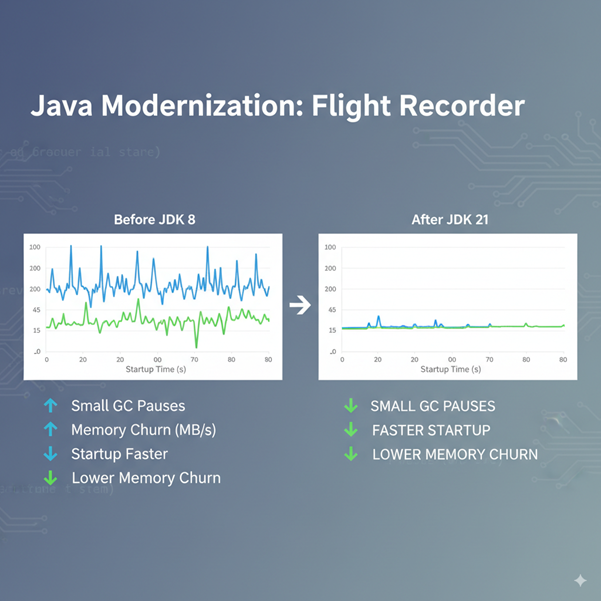
Another quiet win came from observability. The team turned on the built-in flight recorder to capture short profiles under real traffic in both Java 8 and Java 21. They saw shorter pauses with the default collector, faster startup, and less memory churn under peak. Numbers help people say yes. Those small graphs bought patience from product and finance while the team finished the move.
The cutover that no one noticed
After a week of proving sameness in the mirror, they moved a small slice of live traffic to Java 21. Five percent is enough to feel real and small enough to reverse instantly. They watched error rates and p95 latency from a single dashboard that showed both versions side by side. Nothing spiked. They increased to twenty five percent the next day, then to full traffic the following week.
No drama. No all-hands. No weekend outage window. Just a quiet swap and a release note that read like a weather report.
What changed and why it mattered
Only after the cutover did the team start to enjoy the reasons everyone quotes in upgrade decks.
- Startup time dropped, which made autoscaling faster and cheaper.
- The service used less memory per request, which allowed denser packing in containers.
- Build time came down a little.
- Incidents dipped because the logging and HTTP stacks were finally modern.
None of those wins required new language features. Those could wait until the system was calm. When they later tried records and virtual threads, they did it behind a toggle in one service, with a way to turn the experiment off. Features did not drive the upgrade. Stability did.
The conversation with finance
Finance does not want a tour of the JVM. Finance wants to know if risk is falling and if money is being spent wisely. The team reported four facts every Friday.
- Releases kept shipping on schedule.
- Error budgets were healthier on the upgraded service than on the old one.
- Cost to serve one request fell in the upgraded path.
- Rollback remained a one-click route change at all times.
Those lines fit in one slide. That is what earned support for the next service on the list.
Common fears, answered plainly
Will we need a rewrite?
No. Most breakage comes from very old libraries, reflection into internals, and homegrown agents. Replace those and your code runs fine on the new runtime.
Do we have to tune collectors on day one?
No. Start with the defaults. Tune only if real traffic shows a need.
Will partner connections break?
A few might. Test those endpoints early. Add precise exceptions where required. Keep a plan to remove them later.
Should we adopt new language features during the move?
Wait. Ship the upgrade first. Add new features later with a flag and a metric.
A short narrative you can reuse
- Week one was about truth. They discovered what really ran and what touched the outside world.
- Week two was about sameness. The mirror learned to give the same answers as production.
- Week three was about nerve. A thin slice of traffic moved to the new runtime and stayed there.
- Week four was about sharing. The team published a short memo with before and after numbers and picked the next service.
By the end of the quarter, three services were on Java 21. Releases had never stopped. Nothing had caught fire. The upgrade work felt like routine maintenance, not a bet-the-quarter project. That is the feeling you want.
Where LensHub helps without taking the wheel
LensHub speeds up the boring parts that make this story possible. It scans repositories to find the places that break on modern Java, maps external dependencies that deserve early tests, and sets up a comparison lane where outputs can be checked automatically. During the ramp it watches both versions from one view and keeps a clear timeline you can hand to leadership or auditors. Your team stays in control. Guesswork goes away.
Closing thought
Moving from Java 8 to Java 21 is not a heroic act. It is a sequence of quiet, careful steps that protect customers and conserve trust. Prove parity in private. Cut over in slices. Share steady numbers. Then enjoy the faster starts, calmer garbage collection, and easier hiring that modern Java brings.
Upgrade to Java 21 Without Downtime
If you want this story to start at your company next week, begin by choosing one service and standing up the mirror. Everything good flows from that first small move.