The Real Cost of "It Still Works" for CFOs
A CFO's guide to turning legacy burden into financial leverage
"Modernize" often sounds like big budgets and long timelines, so the safe answer becomes "not this quarter." The system keeps running. But "it still works" rarely means "it still pays." Legacy platforms create quiet losses that show up as overtime, vendor creep, slow delivery, audit stress, and talent churn.
The four silent losses
1) Hidden operational overhead
Manual exports, job babysitting, re training on quirky UIs.
Price it: hours per month × loaded rate × 12, plus a buffer for context switching.
2) Innovation penalty
Blocked integrations, delayed analytics, slower time to market.
Price it: expected monthly margin uplift × months delayed.
3) Audit and compliance exposure
Weak logs, unclear ownership, manual change records.
Price it: probability of a material issue × cost of the event.
4) Talent tax
Harder hiring, slower onboarding, churn.
Price it: extra time to hire and onboard × loaded rate, plus lost productivity.
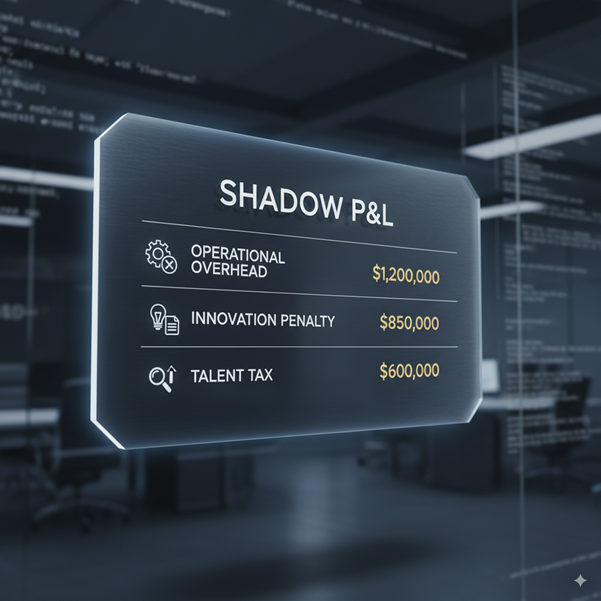
A simple shadow P&L
Legacy Carry Cost =
Operational overhead
+ Innovation penalty
+ Expected audit loss
+ Talent tax
Compare that to a staged modernization plan that returns savings within the same fiscal year.
Case snapshot
A 12-year ERP extension "still worked":
- 180 hours of monthly babysitting
- 2 features delayed per quarter
- 6 weeks of audit prep a year
- 10-week engineer onboarding
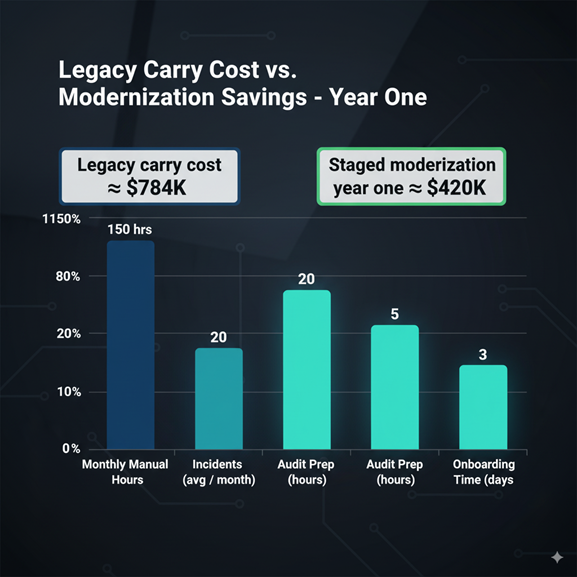
Estimated annual carry cost: ≈ $784K
A staged, non-invasive program cost ~$420K in year one and cut ~60% of carry cost within nine months.
When to act
- Lapsed vendor or LTS support
- Single-owner jobs
- Partners demanding changes your stack cannot support
- Manual audit evidence
- "We need a weekend window" in estimates
Three or more signals mean you are paying a premium for the illusion of stability.
What "good modernization" looks like to a CFO
- See before you spend: automated discovery, dependency and risk maps.
- Protect revenue paths: parity proven in a mirror before cutover.
- Move in slices: small traffic shifts with one-click rollback.
- Retire debt along the way: kill manual jobs and dead code per slice.
- Report one scorecard: build time, incident rate, p95 latency, unit cost, hours removed.
30-60-90 for finance leaders
Days 1–30:
commission a system map, isolate top cost drivers, pick the first slice.
Days 31–60:
prove parity in a mirror, add contract tests, draft a 5% cutover with rollback.
Days 61–90:
shift traffic in steps, retire redundant jobs, publish savings, choose the next slice.
How LensHub helps
- TCO and risk heatmaps tied to business impact
- Dual-track runway to prove parity quietly
- Guardrails for reversible cutovers
- Savings ledger tracking hours removed, incidents avoided, and unit-cost gains
Modernization reads like capital allocation, not a gamble.
Board-ready story
- Manual hours down 40% on the first path
- Incident minutes down 30% where new code runs
- A significant audit risk avoided with traceable change
- Features shipped on schedule
- A repeatable playbook for the next slice
Calculate the Real Cost of Your Legacy
"It still works" is a slow leak. The fix is not a rebuild. If you want numbers for your stack, ask for a LensHub Legacy Cost Brief with a first slice, forecast, and plan you can defend at the next review.