Twin-Track Refactoring Without Breaking Flow
A practical blueprint for twin-track modernization
Teams avoid refactors for a simple reason. The code ships revenue today. Changing it feels like touching a live wire. Yet leaving it alone grows risk, cost, and frustration. The middle path is real. You can keep features moving while you refactor with confidence. This is how LensHub runs a twin-track program so your live systems keep humming while old ones get transformed.
The idea in one line
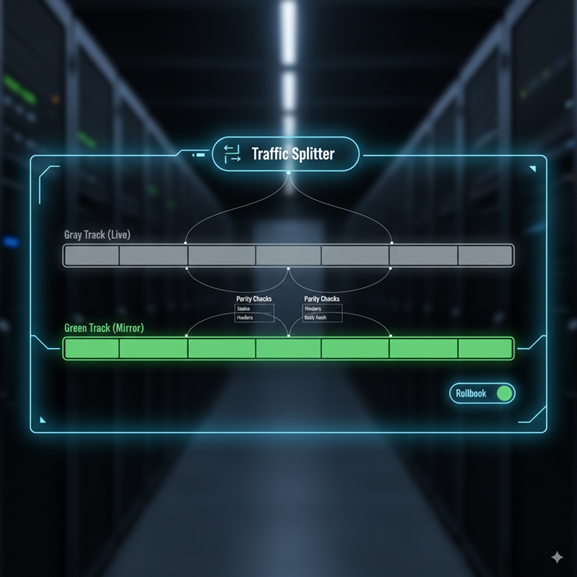
Run two tracks in parallel. The gray track serves customers as usual. The green track is a safe mirror where changes are mapped, rehearsed, and verified against real behavior. You move traffic only when the new path proves parity. Rollback is a switch, not a meeting.
Step 1: See the truth before you touch code
Refactors fail when teams guess. LensHub begins with automated discovery that produces a living map:
- Code and runtime dependencies across services, jobs, and data stores
- Windows-only and framework-locked calls that will fight containers or upgrades
- Shadow systems such as spreadsheets, cron scripts, and unofficial APIs
- Hot paths by revenue impact and incident history
The output is not a slide. It is an interactive graph with owners, risk tags, and "blast radius" estimates. You choose refactor targets based on facts, not folklore.
Outcome: a short list of candidates ranked by value, coupling, and change risk.
Step 2: Build a safe mirror of reality
Twin-track only works if the mirror behaves like production. LensHub spins up an isolated lane that shares config, secrets, and data shape with prod, then replays representative traffic. We use three lenses:
- Parity checks: compare status, headers, body hashes, and key fields
- Latency checks: compare p95 and tail times under realistic load
- Error signature checks: compare stack traces and failure modes
We fail the rehearsal if outputs drift or if p95 rises beyond your threshold. Fixes happen in the mirror, not in front of users.
Outcome: a green light that the new code behaves the same for the same inputs.
Step 3: Refactor by capability, not by file tree
Big-bang refactors invite delay. LensHub scopes a refactor to a single capability with a stable interface: pricing rules, invoice PDFs, address validation, document search. We freeze the contract at the edge and let the inside change freely.
- If the edge is WCF or a brittle adapter, we place a thin facade that keeps requests and responses stable
- If the code mixes IO and business logic, we extract the logic behind a simple port so tests can target it
- If a change touches a shared module, we model consumers and propose an order that reduces blast radius
Outcome: a small, valuable slice that can ship on its own merits.
Step 4: Generate the tests you wish you had
Legacy systems are under-tested in the places that matter. LensHub turns production behavior into a safety net:
- Golden-path examples from real requests
- Edge-case examples from rare states and nulls actually seen in logs
- Consumer-driven contratos at API edges so downstream teams stay calm
- Data parity harnesses for reports and SQL so totals match to the cent
Tests are stored with the code and run in CI for both tracks. Your team gets fast feedback without writing a novel.
Outcome: proof of sameness that developers and auditors trust.
Step 5: Cut over in slices with instant rollback
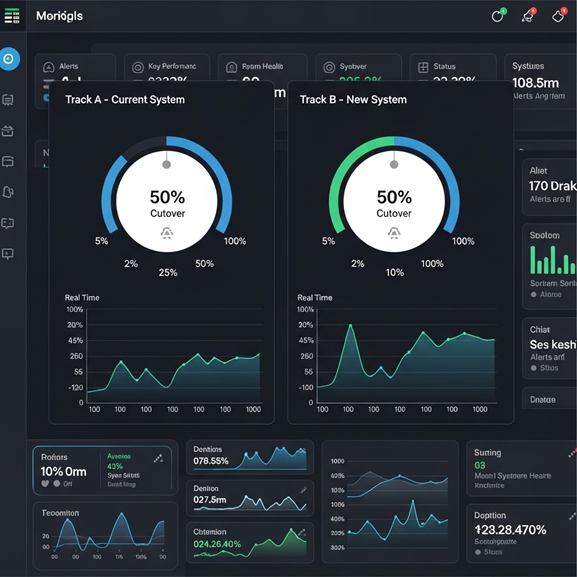
When the mirror is green, we move a sliver of real traffic to the refactored path.
- Start with 5 percent on a single route or customer cohort
- Watch a single dashboard that shows gray and green side by side
- Raise to 25 percent, then 50, then 100 as confidence grows
- Keep rollback as a single route switch or feature flag
No weekend windows. No heroics. If something looks off, you switch back in seconds and keep learning.
Outcome: change without drama and a repeatable rhythm the business can trust.
Step 6: Capture the wins as you go
Refactors should pay their way. LensHub keeps a ledger:
- Incidents avoided on the new path
- Hours of manual babysitting removed
- Build and deploy time reduced
- Cost to serve per request on the new path
- Dead code and duplicate logic retired
These numbers turn modernization into a margin program, not a science project.
Outcome: a board-ready story that funds the next slice.
What this looks like in practice
A payments platform needed to untangle discount logic buried across a monolith. Releases were weekly and could not pause.
- Week 1 to 2: LensHub mapped the code paths, flagged a shared pricing module, and found three shadow scripts a team used to "fix" edge cases at night.
- Week 3: We built the mirror lane, generated parity tests from real invoices, and froze the contract for the pricing endpoint.
- Week 4 to 5: The team extracted pricing rules into a clean service, leaving the old endpoint in place behind a facade. Parity went from 92 percent to 99.9 after fixing rounding and time zone quirks found in rehearsal.
- Week 6: Canary began at 5 percent of traffic. p95 was flat. Error signatures matched. At 50 percent, a rare coupon edge case appeared and was fixed in hours.
- Week 7: The new path took 100 percent of calls. Manual night scripts were retired. The team moved the next capability.
Results after one quarter
- 28 percent fewer incidents tied to pricing
- 19 percent faster invoice generation
- 14 percent lower unit cost on the service
- 0 release freezes
Users never noticed. Finance did.
How teams stay safe during refactors
- Keep contracts stable while internals change
- Compare outputs first, discuss code second
- Move one capability at a time
- Use one dashboard so on-call never guesses
- Treat rollback as a product feature, not a last resort
Twin-track is not extra process. It is respect for the fact that production is a promise.
What LensHub actually does under the hood
- Builds the dependency and runtime map from code, logs, and traces
- Identifies coupling hot spots and shared modules that raise risk
- Generates parity suites and API contracts from real traffic
- Rehearses changes in a mirror with drift detection
- Orchestrates canary and blue-green ramps with guardrails
- Maintains a change timeline and a savings ledger you can show leadership
Your developers keep control of the code. LensHub removes guesswork, paperwork, and blind spots.
Closing thought
Refactors do not have to break your flow. When you see the system clearly, rehearse changes where it is safe, and move traffic in calm slices, modernization becomes routine. You protect today's revenue while building tomorrow's speed.
Ready to Refactor Without Breaking Flow?
If you want a first slice identified and rehearsed in two weeks, ask for a LensHub twin-track brief. We will map the risk, generate the tests, and outline the route that keeps your roadmap on schedule.